BARNES supports its clients who love heritage in the acquisition of historic properties.
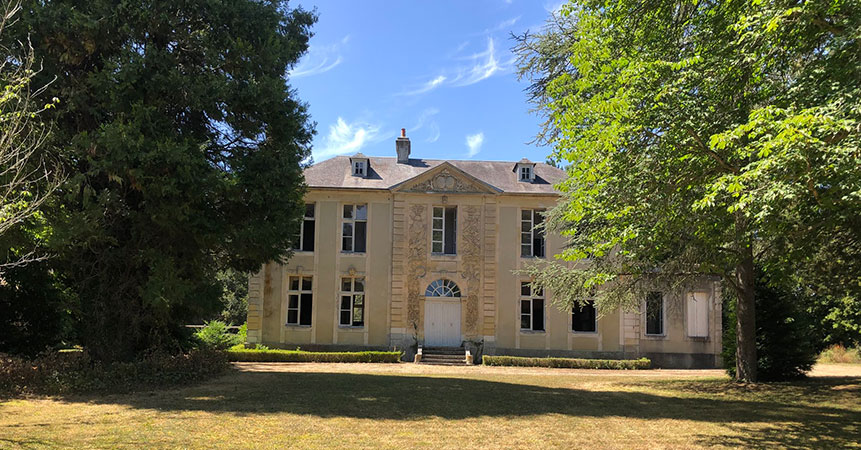
The successive lockdowns allowed the French to rediscover France, its regions, and its unique heritage. They also sparked desires to return to their roots and seek larger homes that are more connected to nature. “The desire to invest in beautiful stone intensifies month after month; BARNES forms the link between the wish to acquire a property with strong architectural or heritage value and the desire for comfortable properties compatible with remote work,” explains Thibault de Saint Vincent, president of BARNES.
Most buyers are French, lovers of the history of France and its beautiful stone, who can wait several years before embarking on these lifetime projects. BARNES offers to accompany them in the restoration and renovation of buildings by finding the tradespeople who can conduct the projects according to the rules of the art, to restore the property to its splendor while respecting its history.
No matter the geographical area, France is rich in historic real estate: from the castles and estates of the Loire to the private hotels of Île-de-France, witnesses of the time of Louis XVI, not to mention the Belle Époque master villas in Cannes.
A rich historical heritage in Île-de-France
Paris and the Paris region are a formidable reservoir for these properties with high heritage value. Often restored, they are offered to a high-end clientele fond of old stones and history. “The region is so dense in historical or classified properties that it is impossible to give an average price for these transactions,” comments Richard Tzipine, general director of BARNES. The architectural diversity according to eras, neighborhoods, and artistic movements is infinite in Île-de-France. This allows each project holder to participate in the preservation of heritage in their own way.”
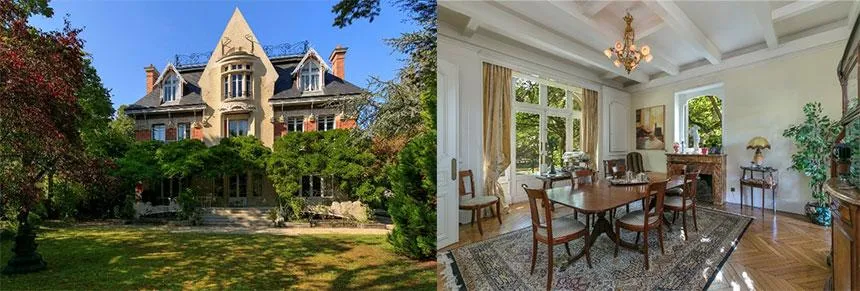
The Villa Berthe, better known as La Hublotière, is a perfect example of history that endures in the Île-de-France real estate heritage. It was built by the famous architect Hector Guimard in 1896, has been fully renovated with passion by artisans, and has managed to preserve period elements while offering modern comfort.
The property, with 363 m² of living space and 97 m² of basement, rises over 3 levels. Each facade presents an originality and a unique identity of Hector Guimard. The interior layout was designed by the architect with a desire to infuse an artistic dimension while paying particular attention to light. The property is built on a closed and wooded plot of 2,032 m², adorned with a rock garden pond and a small priest's garden. Sale price: €3,700,000
The renewal of the Côte de Nacre in Normandy
While prestigious Normandy real estate is often linked to the Côte Fleurie (Deauville, Trouville, Cabourg…), certain factors have allowed the Côte de Nacre, located from Caen to Bayeux and from Ouistreham to Port-en-Bessin, to flourish. “In addition to a more authentic environment close to nature, the more accessible prices of Western Normandy, the proximity to Paris (an average of 2h30), the architecture of white stone buildings (Caen stone), the attractiveness of a dynamic heritage sector, combined with a larger fiber network facilitating remote work, have allowed the Côte de Nacre sector to see its demand explode in the past two years,” explains Christophe Lhomme, consultant at BARNES Normandy.
This strong demand in the Normandy market and this development of activity have led to the emergence of properties referred to as to be renovated, beautiful constructions, whether classified or not, that were not previously sought after and whose architectural and heritage appeal is now recognized. “These properties are even more sought after than those already renovated since they are sold at a lower price and will be restored according to current construction standards while retaining their charm,” he adds. Even if these high-potential properties are uninhabitable in their current state, the notion of renovation no longer worries buyers, as long as the price of the property aligns with its general condition, the anticipated renovation costs, and the architectural and heritage potential it presents.
Proof of the strong demand, these properties that previously remained on the market for many months now find buyers very quickly. “During the first half of 2021, several of our properties to be renovated, whether they are 18th-century castles, rectories, or 11th-century mills, all made of Caen stone, were quickly purchased. All will benefit from quality restoration and are destined for different futures, whether as a primary residence or as a guesthouse or lodging project,” concludes Christophe Lhomme.
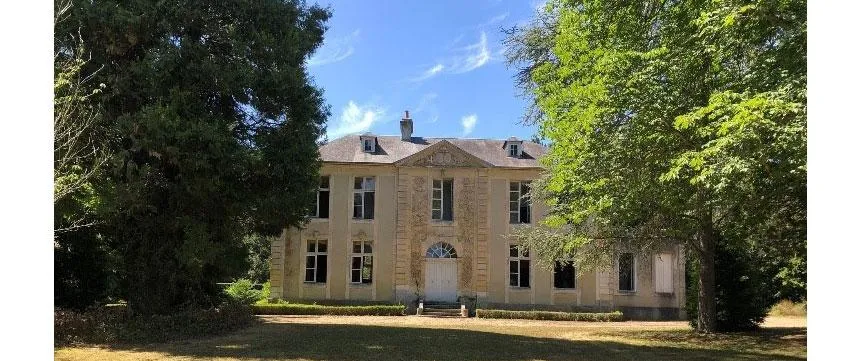
BARNES sold the Château de Ouezy to Audrey and Samy, a young couple from the Rouen region, who are passionate about heritage. They fell in love with this small castle near Caen, for which they dedicate 100% of their free time to restoration, which they carry out themselves and share on their YouTube channel: @aupetitchateau1780.
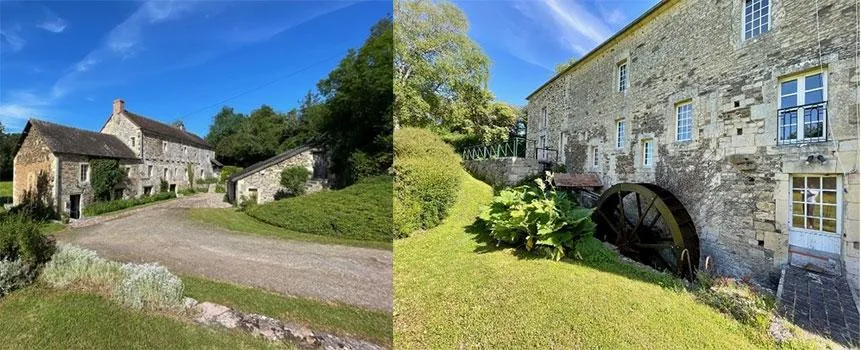
This superb 11th-century mill to be renovated, measuring 280 m², is nestled out of sight on a 3.5-hectare protected site, at the gates of Caen. The 10-room mill, built of Caen stone in the 11th century, includes, on the ground floor, an entrance, a kitchen with dining area, a dining room with fireplace, a living room, a boiler room, a laundry room, and a wine cellar. On the first floor, a large mezzanine landing of 32 m² leads to 3 bedrooms and a bathroom. On the second floor, 3 bedrooms and a shower room. On the top floor, a large attic of about 80 m² that can be converted.
Attached to the house is a workshop whose upper level can be converted and already connects with the upper level of the residence. Outside, there is an outbuilding that includes a garage with attic, a woodshed, and a fruit storage area.
The mill's stream has been cleaned, and the wheel has been perfectly serviced and maintained (it could actually produce green electricity for the residence). The 3.5-hectare plot, incredibly calm and without any overlooking, includes meadows, a hedged path, an orchard, a vegetable garden, and part of a forest bordered by a river. Sale price: €522,000
Recognized architecture in Cannes since 1834
Cannes is now the flagship city of the Côte d'Azur, highly sought after by the French as well as by an international clientele eager to enjoy beautiful villas with their feet in the water or large prestigious apartments in the heart of the city, on the Croisette or in the Californie district with sea views.
The Cannes market is characterized by an extremely variable price per m² from one street to another in the Cannes and Cap d’Antibes area. “In general, this price tends to increase significantly with more and more properties being renovated by professionals,” explains Florent Borrego, director of BARNES Cannes.
The city owes its architectural history and prestige to the succession of great families, first English and then French, each bringing a different style. In 1834, the Chancellor of England settled in Cannes and built the first villa Louise Eléonore. This marked the beginning of an English presence, whose architecture was widely criticized by Prosper Mérimée. Then inspired by the Rothschilds, some French moved in. The architecture became more classical, with reminiscences of the Renaissance. From 1928, the slogan Cannes bains de mer and beach and outdoor activities attracted artists and intellectuals from the United States. “In 1937, painter Jean Gabriel Domergue had a villa built according to his plans, featuring architecture reminiscent of Mediterranean traditions, with rooms opening to the outside and an emphasis on the terrace. The Italian gardens were then adorned with statues of Etruscan inspiration,” adds Florent Borrego.
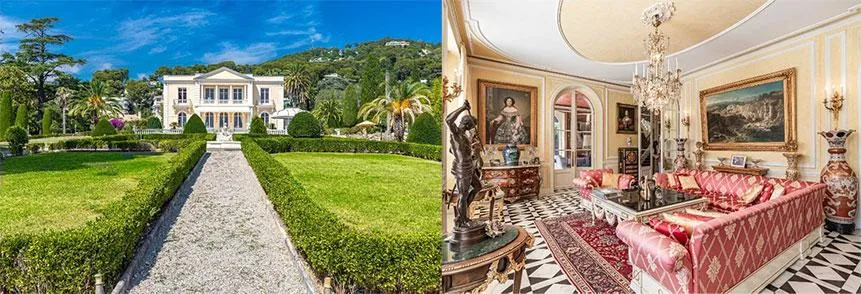
The Château Saint Anne is located in the heart of the Oxford district in Cannes. It was called Château de Monfial, built in 1868 for Captain Robert Vyner from an older structure. In the 1920s, the property belonged to Lady Michellam, who raised the west wing by one floor, then to Miss Capel, who sold it, without maintenance, in 1928 to Louis Hachette for 2,000,000 francs. Also acquiring the Château Valetta, he sought to sell it as early as 1930. The house then took the name Oasis en Beïda and was transformed into a Palladian villa by the family of King Farouk. It resumed and retained the name Château Saint Anne shortly thereafter. “This castle has managed to preserve its Belle Époque interior style, despite changes in owners and names. It is this blend of cultures that allows this castle and other historical properties in Cannes to be so special,” concludes Florent Borrego.
This castle is for sale with BARNES for €16,900,000. It features approximately 550 m² including an entrance hall with a majestic staircase, a bright reception room, an office, and a dining room, a fitted kitchen, 6 bedrooms with bathrooms including a large master suite with dressing room, 2 service bedrooms, and a basement of 220 m² with a wine cellar. To complement this property steeped in history, a flat French garden of over 15,000 m² in the city center is adorned with Mediterranean species, waterfalls, fountains, and a large mirror pool.
The Mazarin district and the Cours Mirabeau centralize the history of Aix-en-Provence
In the Aix-en-Provence area, the most sought-after properties are private hotels and old apartments in the city center, as well as mas and bastides in magnificent properties located nearby. “For the historic market, it is the Mazarin district and the Cours Mirabeau that offer the most historical properties. In these areas, you can expect to pay between €1.2 and €1.3 million for a 150 m² apartment and between €1.5 and €2.2 million for a 250 m² town house,” analyzes François Le Troquer, director of BARNES Pays d’Aix.
Since these properties are very rare, it is necessary to wait on average from 6 months to 1 year, and expect around €2000 to €5000/m² for rehabilitation works. “We assist future buyers as much as possible by offering artisans who possess the required traditional know-how. These renovations are limited by respect for the regulations of France's historical buildings classified as heritage,” adds François Le Troquer.
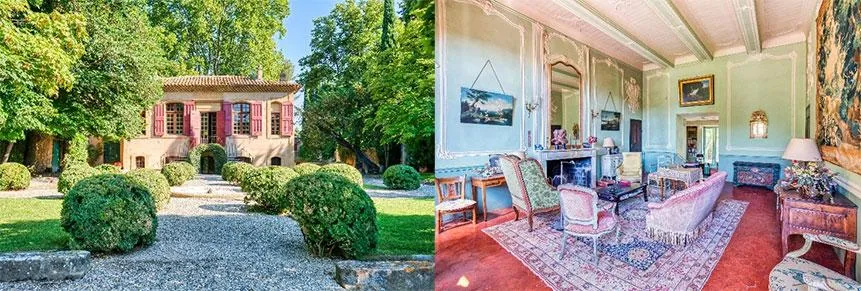
Located in the city center of Aix-en-Provence, this 18th-century pavilion and its 16th-century oil mill of 312 m², nestled in the heart of a park of approximately 4,240 m², is listed as a historical monument. The pavilion is still in the spirit of the time, and the layout of the rooms in the bastide is identical to the original plans. The pavilion is enhanced by a French garden designed in the purest tradition. You can find the entrance hall with the stone master staircase, the large living room from 1710, the library lounge, the dining room, the large kitchen with its pantry and vaulted cellar. A service staircase leads to the corridor that connects to the 3 bedrooms and communicates with the mill converted into 4 rooms. The elegance and architectural quality of the bastide testify to the entire history of a great family of parliamentarians.
“This pavilion was purchased by a retired person attached to the history of the city, who, after turning to the international market, wished to return to their roots. Since this property is listed as a historical monument, renovations or works must be carried out by certified individuals specialized in the field,” concludes François Le Troquer.
French attracted to Portuguese heritage
In Portugal, despite the worst predictions of the pandemic, property prices continued to rise, albeit at a slower pace, and demand remains quite strong. “Since 2012, government programs for the renovation of the historical heritage of Portuguese cities have been implemented, and rental market rules have also changed to help owners renovate their buildings. Francophone buyers are particularly fond of the prestigious apartments with this historical charm that we offer, which are becoming increasingly rare with this rise in demand,” comments Filipa Frey-Ramos, General Manager of BARNES Portugal.
For properties to be renovated, prices range from €2,500 to €4,000/m² and can reach €7,000/m² for ideally located apartments. “To restore these historical properties to their former glory, you should expect an average of €1,800/m² for the works. The main Lisbon neighborhoods with historical properties are Chiado, Príncipe Real, Alfama, Estrela, Campo Martires da Patria, Graça, and Alcantara,” she continues.
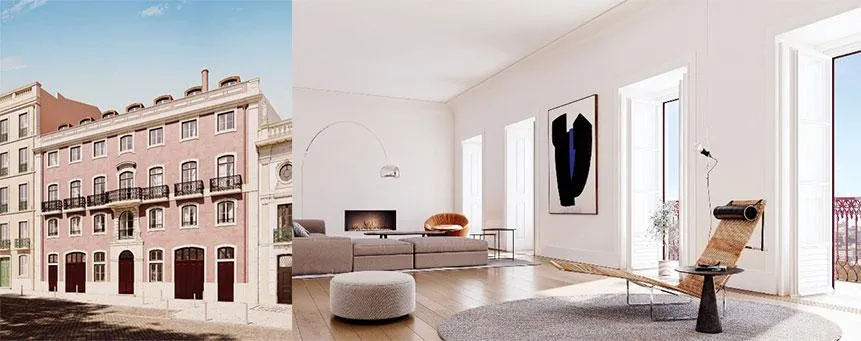
This family apartment with 3 bedrooms, measuring 311 m², is located in a historically rich neighborhood in the heart of Lisbon and offers stunning views of the city of the seven hills. Comprising a large living room, high ceilings, modern and functional design, it overlooks the historic Campo Mártires da Pátria garden, next to the German embassy.
Comments (0)

No comments, be the first to react to this article!